1.0 Personal Computer Components
Cooling may be required for CPU, Video Card,, Mother Board, Hard Drive, etc. Without proper cooling, your computer hardware may suffers from overheating. This overheating causes slow downs, system error messages, and crashing. Also, the life expectancy of your PC's components is likely to diminish. The following are commonly used techniques for cooling the PC or Server components:
Heat Sinks: The purpose of a heatsink is to conduct the heat away from the processor or any other component (such as chipset) to which it is attached. Thermal transfer takes place at the surface of a heatsink. Therefore, heat sinks should have a large surface area. A commonly used technique to increase the surface area is by using fins. A typical processor heat sink is shown in the figure below:
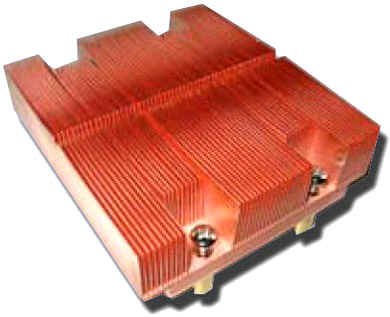
Intel Dual Core Xeon LGA 771 heatsink
As shown in the above figure, the heatsink has several fins, increasing the surface area of the heatsink. This in turn, improves the transfer of heat to interfacing medium (in this case, air) significantly. Normally, a heatsink is accompanied by a fan for faster cooling.
Fan:The Fan is primarily used to force cooler air in to the system or remove hot air out of the system. A fan keeps the surrounding cooler by displacing air around the heatsink and other parts of the computer. Performance of fans is typically measured by air volume displaced per minute (usually in cubic feet per minute, CFM), or by air speed. CFM measurement is more widely used, since it takes into account the size of the fan. A 120x120mm fan will provide better cooling than a 50x50mm fan, even if both produce the same air speed.
A typical CPU fan is shown below.
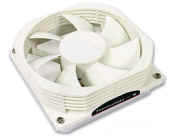
CPU Fan
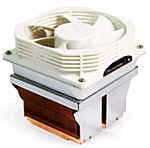
Heatsink with Fan
Thermal Compound:A thermal compound is used for maximum transfer of heat from CPU to the heatsink. The surface of a CPU or a heatsink is not perfectly flat. If you place a heatsink directly on a CPU, there will be some air gaps between the two. Air is a poor conductor of heat. Therefore, an interface material with a high thermal conductivity is used to fill these gaps, and thus improve heat conductivity between CPU and heatsink.
Liquid Cooling Systems : Like a radiator for a car, a liquid cooling system circulates a liquid through a heat sink attached to the processor. First, the cooler liquid passes through the heatsink, and then gets hot due to transfer of heat from the processor to the heatsink. Then the hot liquid passes through the radiator at the back of the case, and transfers the heat to the secondary coolant (air). Now, the liquid is cool enough to pass through the hot processor heatsink, and the cycle repeats. The chief advantage of LCS (Liquid Cooling System) is that the cooling takes place very efficiently (since liquids transfer heat more efficiently than air/solids). The dis-advantages include bulkier cooling system, cost, and additional reliability issues associated with LCS.
Disclaimer: Simulationexams.com is not affiliated with any certification vendor, and Sim-Ex™ Practice Exams are written independently by SimulationExams.com and not affiliated or authorized by respective certification providers. Sim-Ex™ is a trade mark of SimulationExams.com or entity representing Simulationexams.com.A+™ is a trademark of CompTIA® organization.