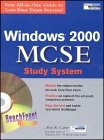
Windows 2000 MCSE Study System
by Alan R. Carter
Editorial Reviews
Amazon.com review:
Windows 2000 MCSE Study System is an odd book by MCSE standards, and the simplest way to put it is this: If you like the concept, you'll love the book; if you don't, this book might well confuse you.
Why? Because the Windows 2000 MCSE Study System isn't really a study guide for the exams; the exams themselves are segmented, and focus on various aspects of Windows 2000. The guide is actually a study course that explains the various aspects of Windows 2000 networks and how they work together, the Microsoft curriculum be damned. By the time you get through this book, you will have an intense working knowledge of Windows 2000 that should serve you well in the real world. If you're the sort of person who is good at recalling vast amounts of details and wants to know everything (because the topics that come up on Microsoft exams are not necessarily always the topics that are important in real life), this is for you; if you're not, the sheer amount of information might flood you under.
The Study System's main strength lies in its detailed and comprehensive walk-throughs. Every MCSE book has hands-on exercises, of course, but the sheer variety and depth of the tutorials in this book practically guarantee Windows 2000 comprehension once you get through them all. Assuming that you have two Windows 2000 computers that are networked together (which, given the relative cheapness of low-end PCs and the easy availability of trial copies of Windows 2000, is probably not a bad idea for any MCSE candidate nowadays), you'll find a clearly written and memorable tutorial for most every aspect of Windows 2000, from disk volumes to creating DNS zones to configuring network settings. Go through every walk-through in the Study System, and you'll have a wealth of actual hands-on experience to use in future systems. Simply put, you will not find a better resource if you like to tinker with live systems.
Unfortunately, the writing itself is long on detail, but short on explanation; this works fine as a reference for post-MCSE candidates, but sells it short for confused pre-testers who still don't quite get critical MCSE concepts. You'll find some excellent walk-throughs for creating DNS zones; but, if you're unclear on exactly what a DNS zone is or why someone might need one, you won't find much hand-holding here. To confuse concepts for the neophyte further, the book doesn't necessarily explain things in order. Again, taking DNS as an example, you'll find "Installing and Configuring DNS" in chapter 7, but won't get a full explanation of what is TCP/IP (the protocol on which DNS is based) until chapter 16. If you're willing to read through the entire book, you'll get all of the detail that you need. But everything that you need to know to comprehend a particular topic might be scattered across two or three chapters, which possibly necessitates two or three reads to nail everything down in a coherent whole.
On the plus side, however, there are many fine and detailed charts that will serve you well in your post-MCSE days. As stated, this book works fine as an on-the-job reference, which is far more than can be said for most MCSE books.
The quizzes at the end of each chapter are well thought through, and give you two question types: Assessment, which comprise multiple-choice questions that measure raw knowledge ("Which tool should you use to create VPNs?") and Scenarios, which are open-ended questions that focus on troubleshooting and problem-solving. Between the two question types, you'll get a good idea of what might appear on the test; but, for a book of this size, the questions are fairly scant (perhaps 8 to 10 per chapter). Still, the CD adds more questions, and the quiz-oriented lab exercises add critical depth.
In short, this is not a book that focuses on the exam, but on Windows 2000 itself--which is both an advantage and a disadvantage. The advantage is that you gain a fuller knowledge than if you simply had studied for the narrowly scoped exams. The disadvantage is that Microsoft has been known to be pedantic on their exams, and a large book that doesn't focus your attention on heavily tested topics might cause you to flunk a section that seemed of little importance at the time. If you're a searcher for knowledge and an experimenter, this book might well be right for you. --William Steinmetz
Book Description
Windows 2000 MCSE Study System is the accurate and comprehensive guide that covers what successful IT professionals need to know about Windows 2000 for on the job and to pass the exams. Covering ALL 4 CORE EXAMS, this one book is a huge value! Alan Carter not only knows Windows, he knows how to teach it! Most certification books are organized by objectives, but Alan Carter organizes his teaching method by concept, making the material more readable, preparing the candidate for the real world.
For any further information or questions, please e-mail to Webmaster at SimulationExams.com
Disclaimer: Simulationexams.com is not affiliated with any certification vendor, and Sim-Ex™ Practice Exams are written independently by SimulationExams.com and not affiliated or authorized by respective certification providers. Sim-Ex™ is a trade mark of SimulationExams.com or entity representing Simulationexams.com.MCSE®,MCTS® are trade mark of Microsoft™