Download CCNA Practice Test Go to Cisco Tests
Simulation Exams recommends
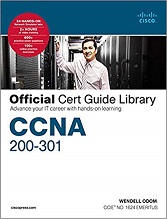
1. CCNA 200-301 Official Cert Guide Library 1st Edition by Wendell Odom
Cisco Press has the only study guides approved by Cisco for the new CCNA certification. The new edition of the best-selling two-book value-priced CCNA 200-301 Official Cert Guide Library includes updated content, new online practice exercises, more than 600 practice exam questions, and more than 2 hours of video training–PLUS the CCNA Network Simulator Lite Editions with 34 free Network Simulator labs (available via download on the companion web site).
CCNA 200-301 Official Cert Guide Library is a comprehensive review and practice package for the latest CCNA exam and is the only self-study resource approved by Cisco. The two books contained in this package, CCNA 200-301 Official Cert Guide, Volume 1 and CCNA 200-301 Official Cert Guide, Volume 2, present complete reviews and a more challenging and realistic preparation experience. The books have been fully updated to refresh the content for the latest CCNA exam topics and to enhance certain key topics that are critical for exam success.
This official study guide helps you master all the topics on the CCNA ICND2 exam, including
· Networking fundamentals
· Implementing Ethernet LANs
· Implementing VLANs and STP
· IPv4 addressing and subnetting
· IPv4 routing
· Implementing OSPF
· IPv6 addressing, subnetting, and routing
· Wireless LANs
· IP access control lists
· Security services
· IP services
· Network architecture
· Network automation
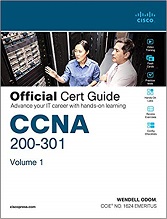
2. CCNA 200-301 Official Cert Guide, Volume 1 1st Edition by Wendell Odom
CCNA 200-301 Official Cert Guide, Volume 1 presents you with an organized test-preparation routine using proven series elements and techniques. “Do I Know This Already?” quizzes open each chapter and enable you to decide how much time you need to spend on each section. Exam topic lists make referencing easy. Chapter-ending Exam Preparation Tasks help you drill on key concepts you must know thoroughly.
· Master Cisco CCNA 200-301 exam topics
· Assess your knowledge with chapter-opening quizzes
· Review key concepts with exam preparation tasks
· Practice with realistic exam questions in the practice test software
CCNA 200-301 Official Cert Guide, Volume 1 from Cisco Press enables you to succeed on the exam the first time and is the only self-study resource approved by Cisco. Best-selling author and expert instructor Wendell Odom shares preparation hints and test-taking tips, helping you identify areas of weakness and improve both your conceptual knowledge and hands-on skills.
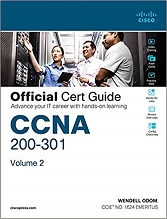
3. CCNA 200-301 Official Cert Guide, Volume 2 1st Edition by Wendell Odom
CCNA 200-301 Official Cert Guide, Volume 2 presents you with an organized test-preparation routine using proven series elements and techniques. “Do I Know This Already?” quizzes open each chapter and enable you to decide how much time you need to spend on each section. Exam topic lists make referencing easy. Chapter-ending Exam Preparation Tasks help you drill on key concepts you must know thoroughly.
· Master Cisco CCNA 200-301 exam topics
· Assess your knowledge with chapter-opening quizzes
· Review key concepts with exam preparation tasks
· Practice with realistic exam questions in the practice test software
CCNA 200-301 Official Cert Guide, Volume 2 from Cisco Press enables you to succeed on the exam the first time and is the only self-study resource approved by Cisco. Best-selling author Wendell Odom shares preparation hints and test-taking tips, helping you identify areas of weakness and improve both your conceptual knowledge and hands-on skills.
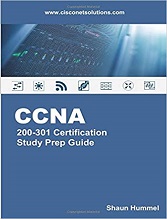
4. CCNA 200-301 Certification Study Prep Guide Paperback – February 2, 2020 by Shaun Hummel
CCNA Certification Study Prep Guide
Study and prepare with this complete certification guide for CCNA 200-301 certification. Take your skills to the next level with a study guide that goes well beyond CCNA for your current career. This certification guide is designed to prepare you 100% for the new CCNA exam.
CCNA 200-301 is the new industry standard networking certification. It is also a prerequisite for higher level CCNP, CCIE and security certifications. CCNA simulation labs are included to practice and learn hands-on CLI configuration skills. There are also 350+ questions, examples and exclusive CCNA exam prep study tools.
CCNA 200-301 Complete Study Guide
350+ Questions and Examples
CCNA Style Simulation Labs
Exclusive Exam Study Tools
CCNA Score Your Best Strategy
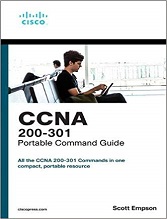
5. CCNA 200-301 Portable Command Guide (5th Edition) 5th Edition by Scott Empson
CCNA 200-301 Portable Command Guide is filled with valuable, easy-to-access information–and it’s portable enough to use whether you’re in the server room or the equipment closet.
The guide summarizes all CCNA certification-level Cisco IOS Software commands, keywords, command arguments, and associated prompts, providing you with tips and examples of how to apply the commands to real-world scenarios. Throughout, configuration examples give you a better understanding of how these commands are used in simple network designs.
This book has been completely updated to cover topics in the new 200-301 exam. Use this quick reference resource to help you memorize commands and concepts as you work to pass the CCNA certification exam. Coverage includes
· Network Fundamentals: IPv4 addressing, subnetting, VLSM, route summarization, IPv6 addressing, cables/connections, CLI
· LAN Switching Technologies: Switch configuration, VLANs, VLAN trunking protocol, inter-VLAN communication, STP, EtherChannel, CDP, LLDP
· Routing Technologies: Router configuration, static routing, OSPF
· IP Services: DHCP, NAT, NTP
· Security Fundamentals: Layer 2 security, ACL traffic management, device monitoring and hardening
· Wireless Technologies: Configuring and securing a WLAN AP
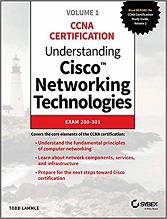
6. Understanding Cisco Networking Technologies, Volume 1: Exam 200-301 (CCNA Certification) 1st Edition by Todd Lammle
Leading Cisco authority Todd Lammle helps you gain insights into the new core Cisco network technologies
Understanding Cisco Networking Technologies is an important resource for those preparing for the new Cisco Certified Network Associate (CCNA) certification exam as well as IT professionals looking to understand Cisco’s latest networking products, services, and technologies. Written by bestselling author and internationally recognized Cisco expert Todd Lammle, this in-depth guide provides the fundamental knowledge required to implement and administer a broad range of modern networking and IT infrastructure.
After reading this essential guide, you will understand:
Network fundamentals
Network access
IP connectivity and IP services
Security fundamentals
Automation and programmability
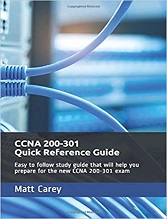
7. CCNA 200-301 Quick Reference Guide: Easy to follow study guide that will help you prepare for the new CCNA 200-301 exam Paperback – by Matt Carey
This guide is great for anyone getting ready to start studying for the new 200-301 exam. You will learn about all of the exam topics plus extra material that will help you pass the exam.
Paperback: 116 pages
Publisher: Independently published (December 9, 2019)
Language: English
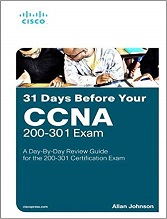
8. 31 Days Before your CCNA Exam: A Day-By-Day Review Guide for the CCNA 200-301 Certification Exam 1st Edition by Allan Johnson
31 Days Before Your CCNA Exam: A Day-By-Day Review Guide for the CCNA 200-301 Certification Exam is the friendliest, most practical way to understand the CCNA Routing & Switching certification process, commit to taking your CCNA 200-301 exam, and finish your preparation using a variety of primary and supplemental study resources.
Thoroughly updated for the current exam, this portable guide offers a complete day-by-day plan for what and how to study. From the basics of switch configuration and IP addressing through modern cloud, virtualization, SDN, SDA, and network automation concepts, you’ll find it here.
Each day breaks down an exam topic into a short, easy-toreview summary, with Daily Study Resource quick-references pointing to deeper treatments elsewhere. Sign up for your exam now, and use this day-by-day guide and checklist to organize, prepare, review, and succeed!
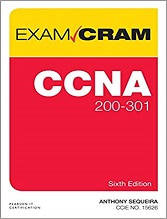
9. CCNA 200-301 Exam Cram (6th Edition) 6th Edition by Anthony J. Sequeira
Cisco CCNA 200-301 Exam Cram is the perfect study guide to help you pass the Cisco CCNA 200-301 exam, providing coverage and practice questions for every exam topic. The book contains an extensive set of preparation tools, including exam objectives, pre-assessments, topic overviews, Exam Alerts, Cram Savers, Cram Quizzes, chapter-ending practice questions, author notes and tips, and an expansive glossary. The book also contains the extremely useful Cram Sheet tear-out: a collection of essential facts and numbers in an easy-to-review format. Complementing all these great study tools is the powerful Pearson IT Certification Practice Test software, complete with hundreds of exam-realistic practice questions. This assessment software offers you a wealth of customization options and reporting features, allowing you to test your knowledge in study mode, practice exam mode, or flash card mode.
The CCNA 200-301 exam covers a broad range of fundamental topics, including:
Network fundamentals
Network access
IP connectivity
IP services
Security fundamentals
Automation and programmability
Disclaimer: Simulationexams.com is not affiliated with any certification vendor, and Sim-Ex™ Practice Exams are written independently by SimulationExams.com and not affiliated or authorized by respective certification providers. Sim-Ex™ is a trade mark of SimulationExams.com or entity representing Simulationexams.com.CCNA™ is a trademark of Cisco® systems